Turning an experimental GenAI tool into an enterprise product used by thousands.
Lead Product Designer
At this stage, speed mattered more than having a perfect research process.I focused on:
It wasn't a perfect environment for design, it was a perfect environment for learning.

Mid-2023, generative AI was moving from a curiosity to a technology that could fundamentally change how people work. Inside RBC, employees across different lines of business were already experimenting with AI — often before formal enterprise guidance and tools were in place.
That created a difficult product challenge:
How might we make generative AI useful and accessible to a diverse workforce, while increasing productivity without compromising trust and risk controls?
The challenge wasn't simply building a chatbot.
We had to design for different levels of AI literacy, different jobs and workflows, and an organization where the cost of getting AI wrong was particularly high.
Research I helped conduct showed a clear divide: 50% of employees were already using AI and wanted more capabilities, while 30% were concerned about the technology and 20% were indifferent.
We needed to build something people would actually want to use — while earning the organization's trust along the way.
RBC Assist started as a deliberately constrained MVP.
Risk approvals for a more ambitious experience were still underway, so the first release used an intent-based interaction model: instead of starting with an open-ended conversation, users selected what they wanted to accomplish. We focused on the six intents most requested by the business:
The MVP launched to 50 users across two lines of business.

The MVP gained traction quickly.
Risk approvals for a more ambitious experience came through, and stakeholders wanted to take the product beyond a small experiment and make it useful across the organization. The scope expanded to include Capital Markets, Global Asset Management, Wealth Management, and Investor Services within Technology & Operations.
I stepped in as Lead Product Designer, taking ownership of the experience as it moved from an intent-based MVP toward a scalable, intent-agnostic product. I focused on four areas:
01 — Rethinking the AI interaction model
Moving from predefined intents to a more natural, open-ended AI experience fundamentally changed how users would interact with the product.
02 — Designing for increasingly complex AI capabilities
As capabilities expanded, the interface had to communicate things that traditional enterprise software rarely had to explain: sources, model behaviour, uncertainty, context, and AI-generated output.
03 — Designing beyond desktop
The MVP was desktop-only, but as adoption grew, I led the responsive experience across desktop, tablet, and mobile, adapting AI interactions, navigation, and information density to different contexts without compromising usability.
04 — Creating a design language for AI
The RBC design system wasn't built around AI experiences yet. I created new patterns and components within the RBC Interface Guidelines (RIG), establishing a design language that could evolve as the product and its capabilities grew.
As we moved beyond the MVP, I had more opportunities to conduct user research. I led two rounds of research with GAM Portfolio Specialists and Investor Services Business Analysts, complemented by continuous design critiques and stakeholder feedback.
The research revealed that users weren't simply asking for “more AI.” They were asking for trust, context, control, and continuity.
These insights changed the product from a simple AI utility into something much closer to an AI workspace.
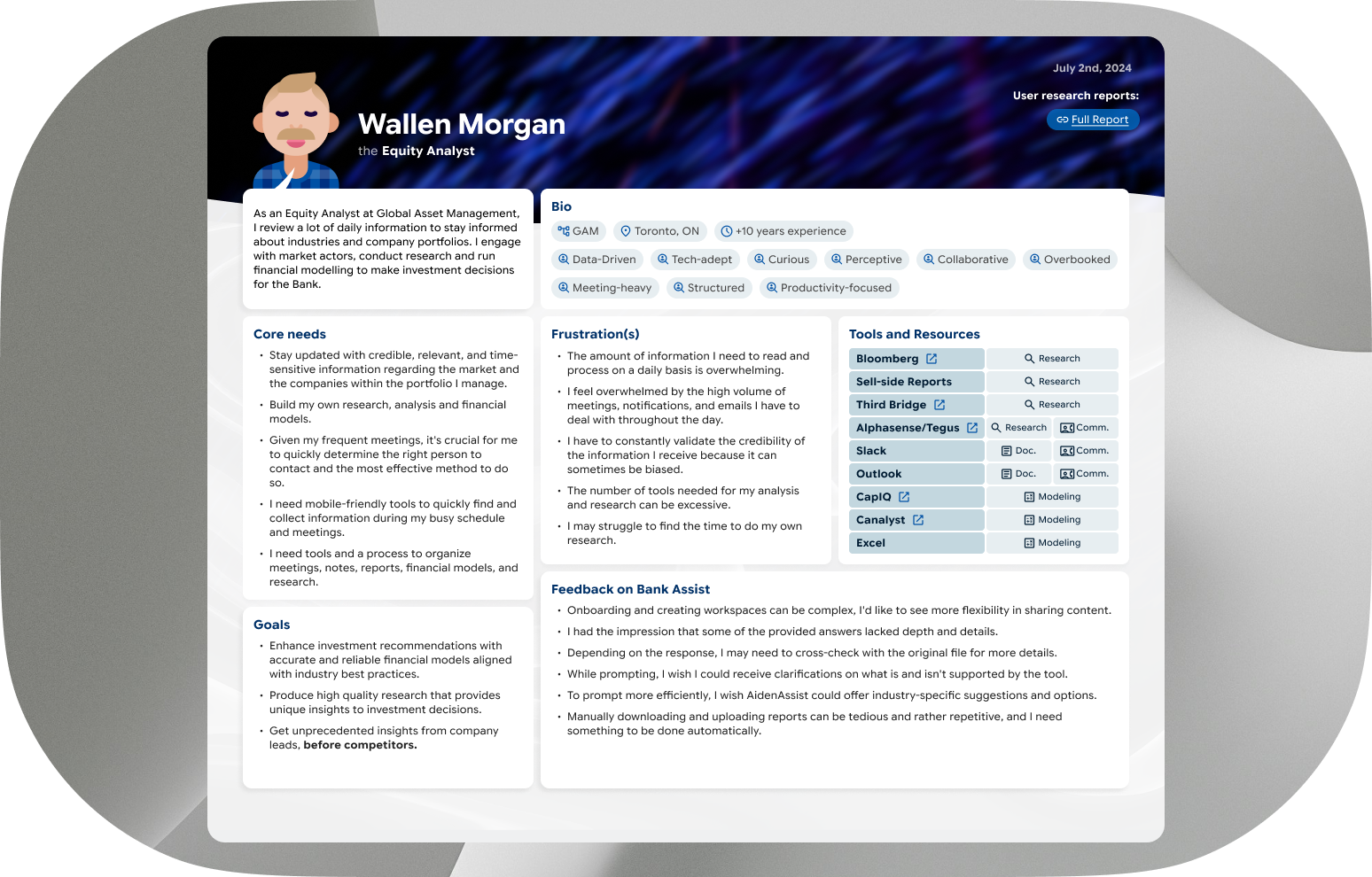
Persona 1: First wave of research conducted with GAM users in June 2024
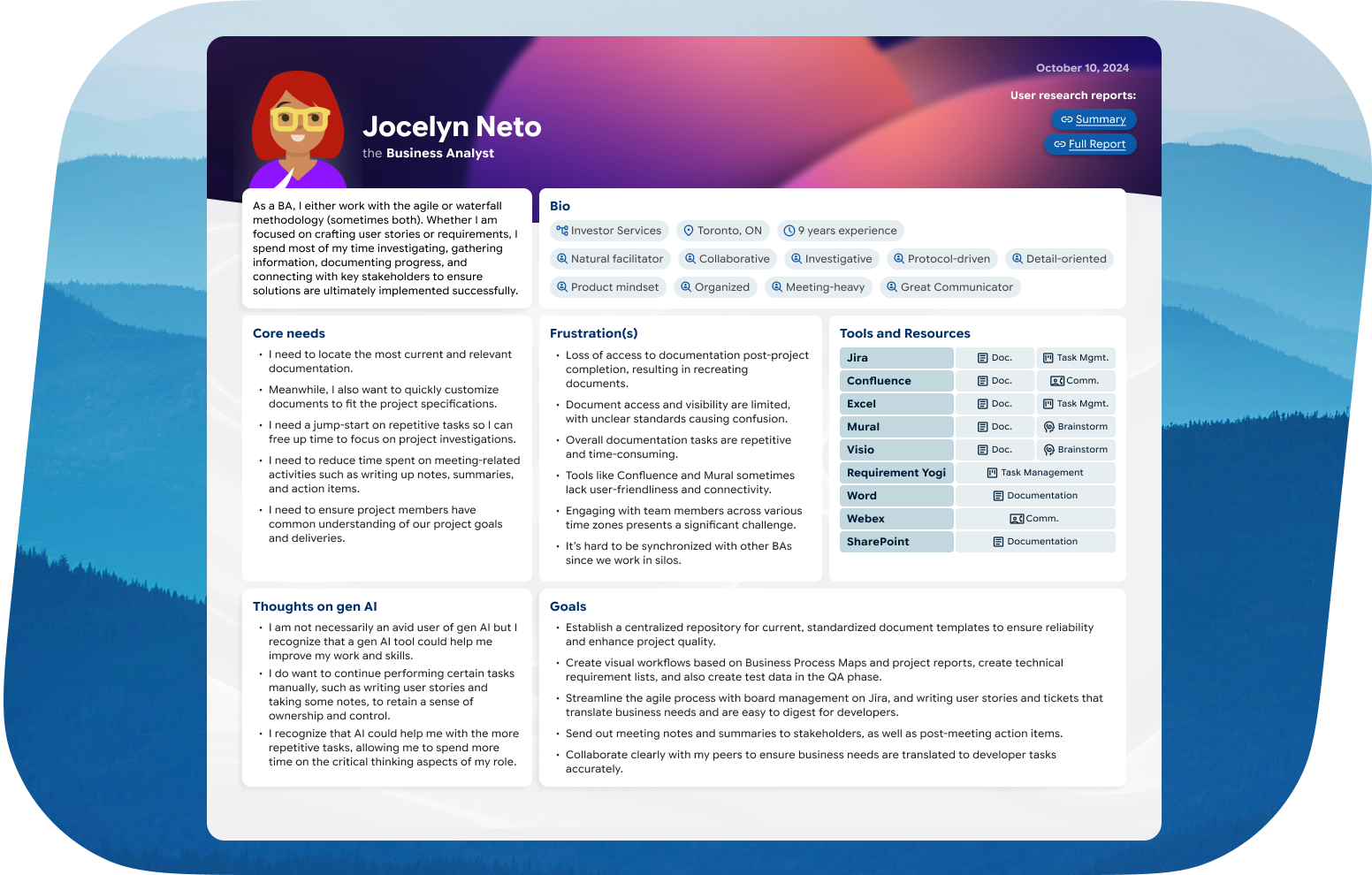
Persona 2: Profile of Business Analysts from the December 2024 research round
In 2023, RBC was still defining what enterprise AI experiences should look and feel like, outside of the work already happening within RBC Borealis. The RBC Interface Guidelines (RIG) gave us a strong foundation, but it wasn't designed for generative AI — there were no established patterns for AI-generated content, prompts, sources, or the higher information density these experiences required.
Rather than simply applying the existing system, I helped create a new layer of it. I developed AI-specific patterns and components while balancing the broader RBC ecosystem with the needs of an emerging product category. RBC Assist also required a more contemporary visual language: softer shapes, larger corner radii, simpler but more varied colour usage, and more flexible component proportions helped create hierarchy and distinguish AI interactions from the more rigid patterns of traditional enterprise software.
The product also had to scale beyond its desktop MVP to desktop, tablet, and mobile. I worked through responsive behaviours and component scaling to keep increasingly dense AI experiences usable across breakpoints, while preserving hierarchy, accessibility, and interaction affordances.
For me, this was less about creating a visual style and more about defining how a new type of product could behave within an established design ecosystem — balancing AI's emerging interaction patterns with accessibility, engineering constraints, scalability, and the need to move fast.
From 50 users to an enterprise capability
The product continued evolving through each sprint, research round, and feedback cycle.What started as a small experiment quickly became something lines of business wanted to adopt and extend for their own workflows.
50
1,500
10,000
20,000
40,000
As the product scaled, RBC Assist eventually evolved into a broader enterprise AI offering, including RBC Assist Pro and collaboration with an external partner.The version I helped design continued to serve thousands of users.

From MVP to latest version before release
01 — You can't design AI without understanding AI
As a Lead Product Designer, I couldn't simply focus on screens and interactions. I had to understand how the technology worked, where it could fail, and how those limitations affected the user experience.
That knowledge allowed me to become a better advocate for users in a highly technical and regulated environment.
02 — Constraints are a starting point, not the destination
The first version wasn't the experience we ultimately wanted to build.It didn't need to be.Starting with a constrained MVP gave us something tangible to learn from, build trust around, and evolve.
Good product design isn't always about getting to the ideal experience first. Sometimes it's about creating the conditions to get there.
03 — Design doesn't scale without collaboration
The product crossed teams, lines of business, disciplines, and levels of AI maturity. There were plenty of moments of friction.
The job wasn't to eliminate that friction. It was to create enough alignment for everyone to keep moving.
Looking back
RBC Assist was one of those projects where the technology, the product, and the design discipline were evolving at the same time. There was no established playbook for designing enterprise GenAI experiences.So we built one as we went.
And I'm proud that I got to help shape that experience from its 50-user MVP into a product used by thousands of people across RBC.